Prices and program rules checked November 11, 2026
$129,180BLS median pay for information security analysts, May 2025
21%Projected job growth, 2025 to 2035 (BLS)
14,100Average openings projected each year (BLS)
$2,000Most VA will reimburse for one approved test
Military cyber and IT work gives you something most career changers do not have: real hours on real networks, often with a clearance attached. What it does not give you is a civilian credential with your name on it. This guide maps the certifications employers and the Defense Department name most often, what each exam costs today, what experience it actually requires, and which military and VA programs can pay for it. Every price and rule below was checked against the issuing organization or agency on November 11, 2026.
The short version
Start with ISC2 CC or CompTIA Security+. Security+ is the one DoD work-role tables name most, so it opens contractor and federal doors.
While you are still in, spend military money first: Army CA, AFCOOL, Navy COOL or Marine Corps COOL. It does not touch your GI Bill.
After you separate, VA reimburses approved tests up to $2,000 each, and VET TEC 2.0 can cover a full tech course if seats remain.
An active clearance is worth protecting. Federal rules let an agency regrant access without a new investigation if you return within two years and your investigation is current.
Pick your rung
The certification ladder
Think of cyber certs in three rungs. The first proves you know the vocabulary and the controls. The second proves you can do a specific job, such as monitoring, cloud or compliance. The third is built for people with years of paid experience, and the issuers will not award it without them. Pay bands below are BLS national medians for May 2025 for the occupation each rung usually feeds, not promises for a first job.
Rung 1
Start
Little or no civilian security title yet. You know networks from the service.
ISC2 CC
Network+
Security+
Computer support specialists $62,890 median. Network and systems administrators $99,130.
Rung 2
Build
Two to four years on a SOC floor, a cloud team or an RMF package.
CySA+
Cloud+
CGRC
Information security analysts $129,180 median. Network architects $134,050.
Rung 3
Lead
Five or more years, often running people, audits or a whole program.
CISSP
CISM
CISA
Computer and information systems managers $175,140 median.
Compare the nine certifications
Costs are the standard U.S. exam prices each issuer listed on November 11, 2026. CompTIA prices are its list voucher prices. Recommended experience on CompTIA exams is advice, not a gate, but ISC2 and ISACA will not certify you until your work history is verified.
Certification
Issuer
Exam cost
Experience
Typical roles
Worth knowing
CC (Certified in Cybersecurity) Start
ISC2
$199
None. ISC2 says you do not need experience.
Entry or junior security roles
ISC2 lists CC as aligned with DoDM 8140.03.
Network+ (N10-009) Start
CompTIA
$399
Recommended, not required: A+ and 9 to 12 months as a junior network admin or support tech.
Network administrator
Good proof of the networking base the security exams assume.
Security+ (SY0-701, V7) Start
CompTIA
$439
Recommended, not required: Network+ and two years in a security or systems admin role.
Security analyst, security engineer, systems administrator
CompTIA lists many DoD 8140 work roles for it. V8 is expected on or around November 17, 2026.
Cloud+ (CV0-004) Build
CompTIA
$399
Recommended, not required: 2 to 3 years as a systems admin or cloud engineer.
Cloud architect, systems administrator
Fits admins moving workloads off premises.
CySA+ (CS0-004, V4) Build
CompTIA
$439
Recommended, not required: about 4 years in a SOC or vulnerability analyst role.
Security analyst
V4 launched June 23, 2026. The V3 English exam retires December 22, 2026.
CGRC Build
ISC2
$599
Two years cumulative, full-time in one or more of seven CGRC domains. Pass first and you can hold Associate of ISC2 status for up to three years while you earn it.
Authorization, risk and compliance (RMF) work
Built around system authorization, the paperwork side of keeping a network accredited.
CISA Lead
ISACA
$575 member / $760 non-member
Five years of information systems audit, control or security work, plus a $50 application fee after you pass.
IT auditor, controls and assurance roles
You can sit the exam before you have the years. You then have five years to apply.
CISM Lead
ISACA
$575 member / $760 non-member
Five years of information security management work across at least three of the four CISM domains.
Security manager, program lead
Aimed at people who run a security program, not only operate tools.
CISSP Lead
ISC2
$749
Five years cumulative, full-time in two or more of eight domains. A related degree or an approved credential (Security+, CySA+, CGRC and CISM are on the list) can cover one year.
Senior engineer, architect, security manager
Pass without the years and you become an Associate of ISC2 with six years to earn them.
Retake bundles cost more: CompTIA lists Security+ and CySA+ with Retake Assurance at $579, and Network+ and Cloud+ at $519. ISC2 charges $50 to reschedule and $100 to cancel in the U.S.
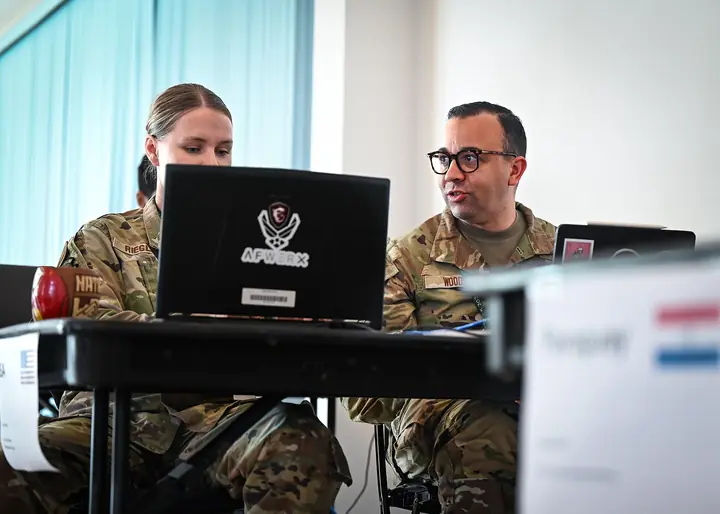
Mission defense teams like this one already do the daily work CySA+ and Security+ describe. Write it down in civilian terms before you leave.U.S. Air Force photo by Master Sgt. Renae Pittman, exercise TACET VENARI, Ramstein Air Base, March 2019. Public domain.
Who pays
Seven ways to pay for the exam
The order matters. Military credentialing money is use-it-or-lose-it and does not touch your GI Bill. VA money comes out of entitlement you may want later for a degree or a trade program, so it usually makes sense to spend service funding first and save VA reimbursement for the tests you take after separation.
VA
GI Bill licensing and certification test reimbursement
Post-9/11 (Ch. 33), Montgomery Active Duty (Ch. 30), Montgomery Selected Reserve (Ch. 1606) and DEA (Ch. 35).
Up to $2,000 per test, including registration and administrative fees.
VA pays you back after the test, and it charges your entitlement based on what it paid. It pays even if you fail, retake, or retest to recertify, as long as you have entitlement left and the test is approved.
File VA Form 22-0803 with the receipt and your results. Prep courses for approved tests can also be paid under Chapter 33 or 35 with VA Form 22-10272. VA does not pay the fee for the certificate document itself.
Veterans with an other than dishonorable discharge, or active-duty members within 180 days of separation. You need at least 36 months of active duty and must be under 62 when approved.
Tuition and fees paid to the provider, plus housing and a books stipend. Capped at 4,000 paid participants per fiscal year.
VA listed 2,022 openings left on November 10, 2026. That number moves, so check it before you plan around a seat. Covered training is non-college-degree work in computer programming, computer software, data processing, information sciences and media application.
If you still have GI Bill entitlement, VA charges one month for each month of full-time training. If you have none left, you can still use it. VA says the program is funded through September 30, 2027. This is not the same as the earlier VET TEC pilot.
Enlisted Soldiers E1 to E9 and warrant officers WO1 to WO5. Commissioned officers lost eligibility on March 19, 2026.
Up to $2,000 and one credential per fiscal year, three credentials per 10 years of service.
The credential must be on Army COOL but does not have to match your MOS. You must sit the exam, or the Army recoups what it paid for training. First-time users complete CA training in ArmyIgnitED and use the MilGears decision tool before requesting funds.
Requests need supervisor or command approval and, per Fort Bragg education guidance, should go in at least 45 days before the course or exam. CA and Tuition Assistance share a combined $4,500 annual total.
$4,500 lifetime cap. Prep courses up to $2,000 and study materials up to $500 per credential goal.
AFCOOL funds unlimited credentials tied to your primary specialty code, two that are not, and recertification of credentials it already paid for, all inside the lifetime cap. Look for the AFCOOL Eligible badge on the credential.
Create the goal in AFVEC and get funding approved before you buy anything. The handbook says requests go in no more than 60 and no fewer than 30 days before the course or exam.
Active and Reserve Sailors (not IRR or VTU), with select officers and DON civilians.
Exam, renewal, maintenance and required administrative fees, as funding allows.
Under SECNAVINST 1540.56C the credential generally has to be mapped to your rating, designator, collateral duty or assignment, shown by the Navy$ icon. Cross-rated Sailors keep eligibility for credentials mapped to their old rating.
You must be able to finish every requirement 30 calendar days before you separate. Funding runs by fiscal year, so ask your Navy College office early in the year.
Active Component Marines, the Selected Marine Corps Reserve, and Marines on ADOS orders.
First come, first served, subject to eligibility and available funds. Separate from Tuition Assistance.
MARADMIN 111/26 (March 17, 2026) calls Marine Corps COOL the official credentialing resource for eligible Marines. Officers and civilians in cyber-coded billets are funded through the Cyberspace Workforce program instead.
Start with your installation Voluntary Education Office. Do not register for an exam until funding is approved in writing.
Service members with at least 180 continuous days on active duty who can finish within their final 180 days of service, with chain of command approval.
You keep military pay while you train or intern. The host organization supplies the training.
VA describes more than 3,000 public and private SkillBridge organizations. Each service can add its own rules, such as fitness standards or completed transition classes.
A cyber internship during SkillBridge is one of the cleanest ways to turn military experience into a civilian reference before your DD-214 is printed.
About scholarships. Some training companies and nonprofits advertise certification scholarships that stack with Army CA or Air Force COOL. Some are real discounts. Others are tied to a course priced well above the exam itself. Ask for the full price in writing, the exam voucher price on its own, and whether the scholarship is applied before or after your military funding.
This guide does not list or rank scholarship providers, and no provider paid to appear here.
Translate your job
MOS, AFSC and rating to civilian cyber jobs
The table uses the Department of Labor's O*NET military crosswalk, which links each military code to civilian occupations with similar work. It shows a selection, not every match, and it is a starting point for your resume, not a hiring guarantee. Your service COOL site lists the exact credentials mapped to your code and which ones it will fund.
Code
Branch
Military title
Civilian occupations O*NET links to it
Check credentials on
17C
Army
Cyber Operations Specialist
Information Security Analysts; Network and Computer Systems Administrators; Computer Systems Analysts; Intelligence Analysts
Army COOL
25B
Army
Information Technology Specialist
Computer Network Support Specialists; Computer User Support Specialists; Network and Computer Systems Administrators; Information Security Analysts
Army COOL
25D
Army
Cyber Network Defender
Information Security Analysts; Penetration Testers; Information Security Engineers; Digital Forensics Analysts
Army COOL
1B4X1
Air Force
Cyber Warfare Operations
Information Security Analysts; Digital Forensics Analysts; Security Managers; Network and Computer Systems Administrators
AFCOOL
1D7X1
Air Force
Cyber Defense Operations
Information Security Analysts; Penetration Testers; Information Security Engineers; Network and Computer Systems Administrators
AFCOOL
CWT
Navy
Cyber Warfare Technician
Information Security Analysts; Penetration Testers; Digital Forensics Analysts; Network and Computer Systems Administrators
Navy COOL
CTN
Navy
Cryptologic Technician (Networks), listed by O*NET as no longer in active use
Information Security Analysts
Navy COOL
1721
Marine Corps
Cyberspace Warfare Operator
Information Security Analysts; Penetration Testers; Information Security Engineers; Digital Forensics Analysts
Marine Corps COOL
0689
Marine Corps
Defensive Cyberspace Chief, listed by O*NET as no longer in active use
Information Security Analysts
Marine Corps COOL
If you held CTN or 0689, O*NET still maps the old code to information security analysts, so list it on your resume with the plain-English duties next to it. Hiring managers outside defense rarely know the codes. They do know words like incident response, vulnerability scanning, firewall rules and access control.
O*NET links 1721 Cyberspace Warfare Operator to analyst, penetration tester and forensics work.U.S. Marine Corps photo by Cpl. Alexis French, Marine Corps Cyber Warfare Group war room opening, March 2025. Public domain.
Your edge
What your clearance is worth, and how to keep it
Some defense contractor and federal cyber jobs ask for a clearance, so a current investigation can help a veteran stand out. It does not mean a clearance alone gets you hired. You still need the certification the position calls for.
The two-year window. Under 32 CFR 147.23, if you have been separated for less than two years and your investigation is otherwise current, the agency regranting access reviews an updated SF-86 and records. A reinvestigation is not required unless that review shows a problem.
Practical takeaway: start the job search before your separation date, not after a long break.
DoD 8140 replaced the old 8570 baseline
If you remember the IAT and IAM levels, that system is gone. DoD Manual 8140.03, issued February 15, 2023, replaced the 8570 manual. It qualifies people by work role and proficiency level using qualification matrices, and the Defense Department described the program as covering about 225,000 cyber workforce civilians, military members and contractors.
Under 8140 a certification is one way to meet a role's foundational qualification. The DoD Cyber Exchange transition paper says there are other avenues, including DoD skills-based courses and experience, and that residential qualification needs at least 20 hours of continuing development a year. Certifications sold as good for life do not count. For a contractor job, read the position's work role code and check that role's matrix before you pay for an exam. CompTIA lists cyber defense analyst, incident responder, vulnerability analyst, security control assessor and system administrator among the 8140 roles tied to Security+.
What the pay really looks like
BLS reports a median of $129,180 for information security analysts in May 2025. The spread is wide, and it follows experience and industry.
$75,090Lowest 10 percent earned less
$129,180Median, May 2025
$199,850Highest 10 percent earned more
BLS counted 192,900 of these jobs in 2025 and projects 21 percent growth to 2035, with about 14,100 openings a year. It says analysts typically need a bachelor's degree, but some start with a high school diploma plus industry training and certifications, and many employers prefer certified candidates. Many analysts come up through IT roles such as network and systems administration, which is the same path a lot of 25B and 1D7 veterans already walked.
Air National Guard cyber Airmen at CRUZEX CYBER. Guard and Reserve service can keep your skills, and sometimes your clearance, current while you work a civilian job.U.S. Air Force photo by Staff Sgt. Madeline Herzog, CRUZEX CYBER, Natal Air Force Base, Brazil, November 2024. Public domain.
Step by step
A transition roadmap
18 to 12 months out
Look up your code and your funding
Search your MOS, AFSC or rating on your service COOL site and on O*NET. Note which credentials show as fundable. Check whether your branch's annual or lifetime cap is still untouched.
12 to 9 months out
Take the first exam on military money
Request Army CA, AFCOOL, Navy COOL or Marine Corps COOL funding inside the window your service requires, then sit CC or Security+. Do not buy a voucher yourself before approval, or you may not be paid back.
9 to 6 months out
Translate your record
Rewrite evaluations and awards into civilian tasks: what you monitored, what you hardened, what you reported and to whom. Record your clearance level and investigation date.
Final 180 days
Use SkillBridge if your command approves it
A cyber internship gives you a civilian supervisor, a reference and often a job offer. Apply early, since host slots and command approval both take time.
After separation
Use VA for the next rung
Apply for VA education benefits if you have not, then use test reimbursement for CySA+, Cloud+ or CGRC. If you want a full course and meet the 36-month rule, check VET TEC 2.0 openings.
Years three to five
Aim for CISSP, CISM or CISA
Once your paid experience adds up, the senior certifications open management and audit roles. Security+ or CySA+ can count for one of the five CISSP years.
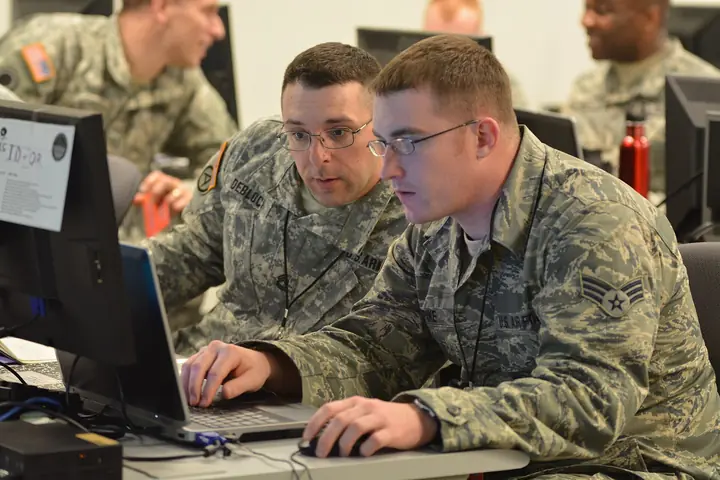
National Guard Red Cell members plan injects during Cyber Shield 2014. Exercise roles like red cell and defender resemble civilian penetration testing and SOC work.U.S. Army National Guard photo by Capt. Kyle Key, Cyber Shield 2014, April 2014. Public domain.
Frequently asked questions
Which cyber certification should a veteran get first?
If you have little hands-on security time, ISC2 CC ($199, no experience required) or CompTIA Security+ ($439) is the usual first step. Security+ is named for many DoD 8140 work roles, which matters if you want a defense contractor or federal job. If you already ran networks, Security+ first and then CySA+ or Cloud+ is a common ladder.
Will the GI Bill pay for Security+ or CISSP?
VA reimburses approved licensing and certification tests up to $2,000 per test, and it charges your entitlement based on the amount paid. Check that the exact exam is approved in VA's licensing and certification search before you sit it, then file VA Form 22-0803 with your receipt and results.
Is VET TEC still available in 2026?
Yes, as VET TEC 2.0. VA listed 2,022 of its 4,000 per-year paid openings available on November 10, 2026, and says the program is funded through September 30, 2027. You need 36 months of active duty, an other than dishonorable discharge (or be within 180 days of separating), and be under 62.
How much can a Soldier get from Army Credentialing Assistance now?
Up to $2,000 and one credential per fiscal year, with a limit of three credentials per 10 years. Commissioned officers are no longer eligible as of March 19, 2026. The credential has to be on Army COOL, but it does not have to match your MOS.
Does my security clearance carry over after I separate?
Federal rules say that if you have been out for less than two years and your investigation is otherwise current, the agency regranting access reviews an updated SF-86 and records. A full reinvestigation is not required unless that review raises an issue. After two years, plan on a new investigation.
Do I need a degree to work in cybersecurity?
BLS says information security analysts typically need a bachelor's degree, but some enter with a high school diploma plus industry training and certifications, and many employers prefer certified candidates. Military experience in a related role counts toward the work history employers ask for.
What replaced DoD 8570?
DoD Manual 8140.03, issued February 15, 2023. It qualifies people by work role and proficiency level. A certification is one way to meet a foundational qualification, alongside options such as education and DoD training, and residential qualification needs at least 20 hours a year of continuing development.
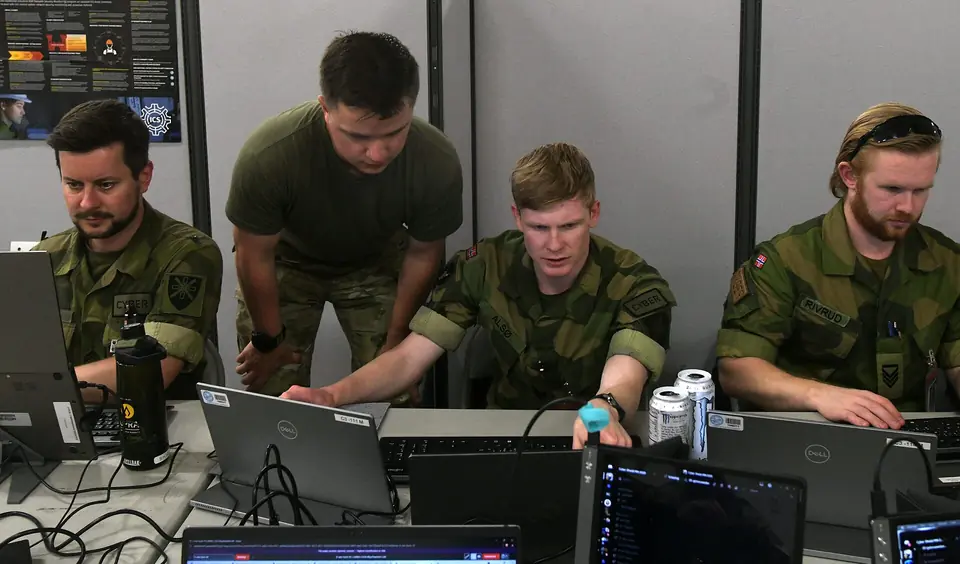
U.S. Army photo by Sgt. 1st Class Jon Soucy, exercise Cyber Shield, Virginia Beach, July 2025. Public domain. Source file.
U.S. Air Force photo by Master Sgt. Renae Pittman, exercise TACET VENARI, Ramstein Air Base, March 2019. Public domain. Source file.
U.S. Marine Corps photo by Cpl. Alexis French, Marine Corps Cyber Warfare Group war room opening, March 2025. Public domain. Source file.
U.S. Air Force photo by Staff Sgt. Madeline Herzog, CRUZEX CYBER, Natal Air Force Base, Brazil, November 2024. Public domain. Source file.
U.S. Army National Guard photo by Capt. Kyle Key, Cyber Shield 2014, April 2014. Public domain. Source file.
U.S. military photos are works of the U.S. government and in the public domain. Their appearance does not imply endorsement by the Department of Defense or any service.
Sources
Figures change. Each source below was opened and checked on November 11, 2026. Confirm any price or rule with the issuer or your education office before you pay.
U.S. Department of Veterans Affairs, “Licensing and certification tests and prep courses” (last updated October 23, 2026). www.va.gov. Retrieved November 11, 2026.
U.S. Department of Veterans Affairs, “VET TEC 2.0 (high-tech program)” (openings as of November 10, 2026). www.va.gov. Retrieved November 11, 2026.
VA Education Service, “VET TEC 2.0 Training Provider FAQs” (funding through September 30, 2027). benefits.va.gov. Retrieved November 11, 2026.
Official Army Benefits Website, “Army Credentialing Opportunities On-Line (COOL)” (ALARACT 102/2025; March 19, 2026 changes). myarmybenefits.us.army.mil. Retrieved November 11, 2026.
Fort Bragg Army Continuing Education System, “Tuition Assistance and Credentialing Assistance Programs”. home.army.mil. Retrieved November 11, 2026.
Soldier for Life, “Use education benefits before retirement” (2026-04; combined $4,500 TA and CA). soldierforlife.army.mil. Retrieved November 11, 2026.
Air University CCAF, “Air Force Credentialing Opportunities Online (AFCOOL)” and AFCOOL Handbook. www.airuniversity.af.edu. Retrieved November 11, 2026.
Department of the Navy, SECNAVINST 1540.56C, Navy Credentialing Opportunities On-Line. www.secnav.navy.mil. Retrieved November 11, 2026.
U.S. Marine Corps, MARADMIN 111/26, “Increasing awareness on Marine Corps COOL” (March 17, 2026). www.maradmins.com. Retrieved November 11, 2026.
VA Outreach and Transition Services, “SkillBridge”. www.benefits.va.gov. Retrieved November 11, 2026.
U.S. Department of Defense, “DoD CIO Issues DoD Manual 8140” (February 15, 2023). www.defense.gov. Retrieved November 11, 2026.
DoD Cyber Exchange, “Transition from DoD 8570 to DoD 8140 Cyber Workforce Qualification Program” (August 7, 2024). dl.dod.cyber.mil. Retrieved November 11, 2026.
Electronic Code of Federal Regulations, 32 CFR 147.23, “Breaks in service”. www.ecfr.gov. Retrieved November 11, 2026.
Bureau of Labor Statistics, Occupational Outlook Handbook, “Information Security Analysts” (last modified August 27, 2026). www.bls.gov. Retrieved November 11, 2026.
O*NET OnLine, Military Crosswalk search for 17C, 25B, 25D, 1B4X1, 1D7X1, CWT, CTN, 1721 and 0689. www.onetonline.org. Retrieved November 11, 2026.
ISC2, “Exam pricing” (Americas standard registration). www.isc2.org. Retrieved November 11, 2026.
ISC2, CC, CISSP and CGRC certification and experience requirement pages. www.isc2.org. Retrieved November 11, 2026.
CompTIA, Security+, Network+, Cloud+ and CySA+ certification pages (US list voucher prices). www.comptia.org. Retrieved November 11, 2026.
ISACA, CISA and CISM certification pages (exam fees and experience requirements). www.isaca.org. Retrieved November 11, 2026.
GI Bill® is a registered trademark of the U.S. Department of Veterans Affairs (VA). More information about education benefits offered by VA is available at the official U.S. government website at https://www.benefits.va.gov/gibill. Certification names are trademarks of their owners. Veteran Trade Schools is independent and is not affiliated with VA, DoD, ISC2, CompTIA or ISACA.
Sources: VA, DoD, the military services, BLS, O*NET, ISC2, CompTIA and ISACA, checked November 11, 2026
Page last updated November 11, 2026
Independent directory · not a VA website. Not affiliated with VA, DoD, or any school.